
Xiamen Gachn International Co., Ltd. presents a capacity planning guide for PP woven valve sack plants, built from the commissioning records of more than 50 FK008-III projects worldwide, including plants in Uzbekistan, Saudi Arabia and several large Chinese manufacturing bases. Most buyers start the conversation with a single question: how many bag making machines do I actually need? The answer is never the nameplate speed divided by the target output, because a valve bag making machine spends part of every shift on reel changes, shift handover and grade changes. This guide walks through the seven calculations that turn a rated speed into a plant you can actually run.
The FK008-III holds a stable 110-120 bags per minute, so take 115 bags per minute as the working figure. That is 6,900 bags per hour on paper. Apply a 90% effective-time factor for reel changes, splicing, shift handover and short stops, and the machine delivers roughly 6,210 bags per hour of scheduled production.
From there the monthly figure follows directly. On a two-shift pattern of 20 productive hours a day and 26 days a month, one machine produces about 3.2 million bags a month, or close to 38 million bags a year. This is why Gachn quotes a 30-million-bag annual capacity as a comfortable reference line for a single FK008-III: the reference already carries a margin for maintenance windows, seasonal demand swings and product mix changes.
For the specification side of the decision, the seven checks that decide your cost per bag are worth reading alongside this capacity model. Write your own assumptions down before comparing suppliers. A plant running three shifts, or one that changes bag specification twice a day, will land on a different number from the same machine, and the difference is usually larger than the difference between two competing quotations.
Start with the tonnage or bag count your customers actually commit to, not the capacity you hope to sell. A cement producer shipping 2.5 million tons a year in 50 kg sacks needs 50 million bags before any safety stock; at 38 million bags per machine, that is two machines, not one and a quarter.
Two machines also buy something a single machine cannot: redundancy. With a documented failure rate below 0.5% and the ability to run continuously for up to 30 days without scheduled downtime, a single FK008-III is genuinely reliable, but no plant should depend on one bag making station during peak season. The second machine covers scheduled maintenance, absorbs a rush order and allows you to run different bag specifications in parallel instead of stopping the line to change over. For plants comparing machine platforms before fixing the count, the PP woven block bottom valve bag making machine documentation sets out the block-bottom construction this capacity model assumes.
Bag count is only half of the capacity equation; the other half is fabric. At a typical bag body weight of 75 g ± 2 g, 30 million bags consume about 2,250 tons of coated PP woven fabric a year, and 38 million bags consume roughly 2,900 tons. That tonnage is what your circular weaving and coating sections must deliver, and it is the number to hand to the loom and laminating suppliers when the line is planned as a whole.
The ± 2 g tolerance deserves attention at this scale. If every bag runs 2 g heavy, 30 million bags absorb an extra 60 tons of polypropylene a year, which is a material cost with no customer value attached. Full servo control with 2 kHz response loops and dynamic error below 0.01 mm is what keeps the bag body weight inside the lower half of that tolerance band rather than drifting upward.
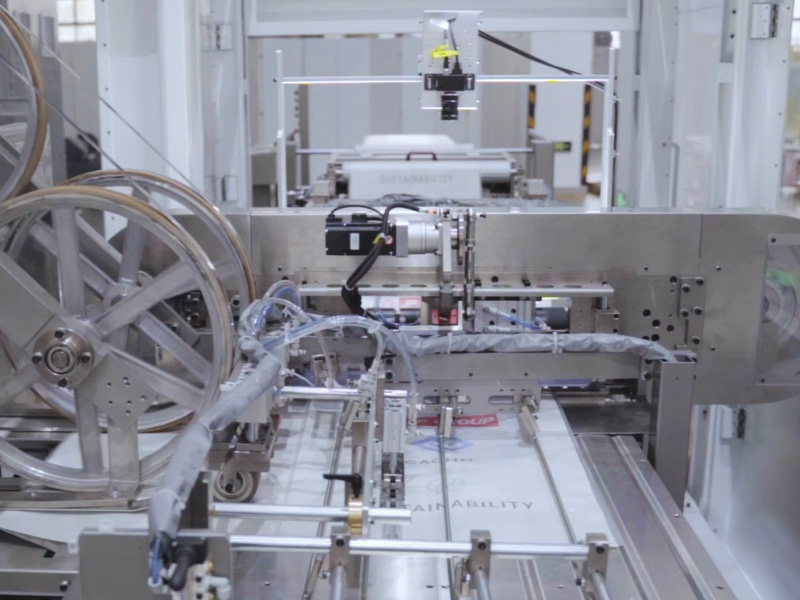
A bag making machine that runs 6,210 bags an hour fills a warehouse faster than most people expect. One eight-hour shift is already about 50,000 bags, or 3.7 tons at 75 g per bag. Plan a finished-goods buffer of at least one shift of output per machine, in bundle form, so that a filling line stoppage or a truck that arrives late does not force the bag making station to stop and restart.
Keep the buffer close to the bag making discharge and keep it dry. PP woven sacks pick up moisture in humid conditions, and a stack that sits for a week in an open shed will cause filling and palletizing problems that have nothing to do with bag quality. The same -20°C to 60°C operating range that lets the machine run in extreme climates does not protect the finished bags after they leave the stacker.
Each FK008-III needs about 12 m long x 7.5 m wide x 2.5 m of floor space, a 380 V three-phase five-wire supply with 150 kW total and 60 kW operating power, cooling water at 0.6 cubic meters per hour and compressed air at 6-7 bar and 3 cubic meters per minute. Two machines double the operating load to about 120 kW, the water to 1.2 cubic meters per hour and the air to 6 cubic meters per minute, before you add aisles, fabric storage and finished-goods space.
The complete utility and footprint schedule is published in the verified technical parameters and factory setup guide, and it is worth checking line by line before the building is designed. This is where new projects most often overrun. A complete production line building should be no less than 85 m x 60 m once equipment and material handling area are included, and the layout should leave a straight path from fabric roll intake to bag discharge so that a second machine can be added later without rebuilding the aisle. If the local grid is unstable, the optional 160 V-480 V wide voltage module is worth specifying at the ordering stage rather than retrofitting after commissioning.
Capacity planning usually stops at equipment and forgets the payroll that comes with it. Without inspection automation, one operator per machine is the realistic assumption in most plants. With the optional AI vision inspection system fitted, one operator can manage 3-4 machines, because the system detects base fabric defects and bag-making defects automatically with a false negative rate as low as 0.05%, instead of relying on a person watching bags pass at two per second.
That difference is worth roughly RMB 240,000-360,000 per production line per year in labor cost, and it changes the shape of the shift plan: fewer people, but each one needs to read defect data rather than only load reels. Plan for one technician per shift who can act on the inspection log, and use the 1-2 day HMI training window during commissioning to build that habit from the first production run.
Two patented details move the cost per bag at plant scale. The bottom sealing process uses single-sided film with a narrow overlap, saving about USD 1 of raw material for every 500 bags, which is roughly USD 60,000 a year on a 30-million-bag line. Vector frequency conversion and dynamic pressure adjustment cut motor energy consumption by 10-30%, and the power module drops into standby automatically when the machine is idle.
Neither number decides a purchase on its own. Together they decide whether a plant that runs 30 million bags a year is profitable at a market price set by competitors running older equipment, and that is the comparison worth putting in front of a finance committee.
Capacity numbers only hold if the project is delivered as planned. Gachn tests 100% of each machine before shipment, packs to export ocean standard, assists with customs clearance and sends technicians on site, with installation, commissioning and trial production completed within 30 days of arrival. Trial parameters are tuned until the agreed qualification rate is reached, bilingual manuals and video tutorials support local training, the full machine carries a 12-month warranty on electrical and mechanical parts, control system upgrades are free within three years and fault inquiries are answered within 24 hours.
Every figure in this guide comes from published FK008-III documentation and from projects already in production. Bring your own bag specification, shift pattern and annual tonnage, and Gachn will return a capacity plan with the machine count, utility load and floor layout that match them.
How many bags can one FK008-III produce in a month?
At a stable 115 bags per minute with a 90% effective-time factor, one machine produces about 6,210 bags per hour. On a two-shift pattern of 20 productive hours a day and 26 days a month, that is roughly 3.2 million bags a month, or close to 38 million bags a year.
Why does Gachn quote 30 million bags a year instead of 38 million?
The 30-million-bag figure is a planning reference that already carries margin for maintenance windows, seasonal demand and specification changes. The 38 million figure is the arithmetic ceiling under ideal shift assumptions, and no plant should plan production at its ceiling.
How much fabric does a 30-million-bag plant need?
At a typical bag body weight of 75 g ± 2 g, 30 million bags require about 2,250 tons of coated PP woven fabric a year, rising to roughly 2,900 tons at 38 million bags. That tonnage sets the requirement for the circular weaving and coating sections.
Do I need two machines for a 50-million-bag contract?
Yes. At close to 38 million bags per machine per year, a 50-million-bag commitment needs two machines. The second unit also provides redundancy for scheduled maintenance and lets you run two bag specifications in parallel.
What utilities do two machines require?
About 120 kW of operating power against 300 kW total connected load, cooling water at 1.2 cubic meters per hour and compressed air at 6 cubic meters per minute at 6-7 bar, on a 380 V three-phase five-wire supply, plus roughly 12 m x 7.5 m x 2.5 m of floor space per machine.
How many operators does the line need?
One operator per machine without inspection automation, or one operator for 3-4 machines when the optional AI visual inspection system is fitted. Operators can run the bilingual HMI after 1-2 days of training during commissioning.
How long before the line reaches qualified output?
Installation, commissioning and trial production are completed within 30 days of arrival, with parameters optimized until the agreed qualification rate is reached before acceptance.
اشترك للحصول على آخر الأخبار. ابقَ على اطلاع بأحدث التوجهات.
 IPv6 الشبكة المدعومة 闽ICP备20010238号-3